What is an inclining test in maritime engineering?
Last updated on July 13th 2026

An inclining test (or inclination test) is a physical, regulatory-required procedure used to precisely determine a vessel’s lightship displacement and the exact coordinates of its vertical center of gravity (VCG).
An inclining test determines a vessel’s lightweight and center of gravity, two parameters that form the absolute foundation of the vessel’s stability documentation. These values are essential to verify that a vessel meets the required maritime stability criteria and can operate safely under different loading conditions.
How does an inclining test work?
During an inclining test, calibrated weights are systematically shifted across the deck while naval architects carefully measure the resulting heel angles. By combining these precise angular measurements with the vessel’s hydrostatic data, engineers calculate the metacentric height (GM) and initial stability characteristics.
The final results of the inclining test are used to create or verify the vessel’s official stability documentation, such as the stability booklet required for global regulatory compliance.
Why vessel stability and VCG calculations matter
Stability is one of the most critical characteristics of any marine structure. It determines how a vessel responds to external forces such as ocean waves, wind, and sudden changes in loading conditions.
Loss of stability can have severe consequences. In extreme cases, it leads to capsizing, posing serious risks to crew safety, cargo, and the marine environment. Accurate stability information is therefore essential for daily safe vessel operations.
An inclining test provides the reliable, empirical stability parameters needed to ensure compliance with applicable international regulations and classification society requirements (such as DNV, Bureau Veritas, or Lloyd’s Register).
“Accurate stability data is the foundation of safe and compliant vessel operations.”
When is an inclining test required by IMO regulations?
According to the International Maritime Organization (IMO), specific criteria dictate when a vessel must undergo this procedure:
- Vessel Length: All passenger vessels and cargo ships with a length of 24 meters or more must undergo a mandatory inclining test. Cargo vessels below 24 meters are subject to different stability requirements, depending on the vessel’s flag state.
- Significant Modifications (Retrofits): An inclining test is required after major conversions or mobilizations. If a vessel’s lightship weight changes by 2% or more, or the longitudinal center of gravity (LCG) shifts by 1% or more of the vessel’s length, a lightweight survey and a new inclining test are typically required.
What are the steps of an inclining test?
Because small measurement inaccuracies can significantly distort the final stability parameters, executing an inclining test requires a highly structured, 5-step procedure:
- Controlled preparation
The vessel must be placed in a strictly controlled condition. Tanks must be either completely empty or pressed full to eliminate the Free Surface Effect. Cargo, tools, and movable items are carefully accounted for, and environmental conditions like wind and mooring line tension are minimized. - Positioning calibrated test weights
Known, certified weights (such as concrete blocks or water bags) are placed on deck and shifted transversely to create controlled, measurable heel angles. - Measuring precision heel angles
The resulting heel angles are measured with high precision using specialized electronic inclinometers or traditional pendulums. (Note: This is where engineers dive into complex stability formulas, calculating the exact shift in the center of gravity). - Recording draught readings
Accurate draught measurements are taken at the bow, stern, and midships to determine the vessel’s exact displacement and trim during the test. - Final stability calculations
Using all collected data, naval architects calculate the vessel’s vertical center of gravity (VCG) and update the mandatory stability booklet.
On-site execution and classification societies
Executing an inclining test requires seamless coordination between surveyors, naval architects, the vessel crew, and the attending classification society surveyor who witnesses the test for official certification.
After the successful on-site works, the analyzed data is used to formally update the vessel’s stability documentation, ensuring your vessel is legally cleared for its next offshore campaign.
Our field of expertise
Learn more about inclining tests
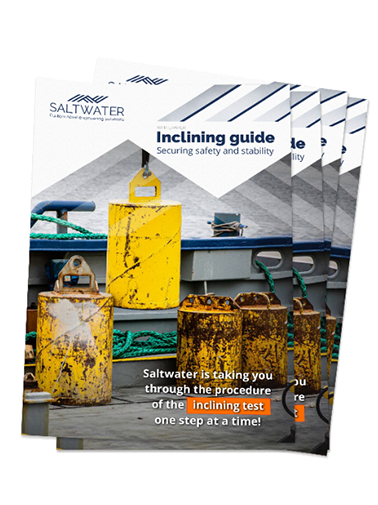
An inclining test requires careful preparation, technical expertise, and precise measurements. Our whitepaper explains the theory, planning, and on-site execution step by step.