BWTS compliance after 2024: is your system actually working?
Last updated on September 4 2026

The ballast water industry has entered a new phase.
For years, the main question for shipowners and operators was relatively straightforward: do we have a compliant ballast water treatment system on board?
The final phase of the IMO D-2 implementation schedule was completed in September 2024. By then, affected ships were expected to meet the D-2 ballast water performance standard. This triggered a major wave of BWTS installations and retrofits across the global fleet.
Now that these systems have been operating in practice for some time, another question is becoming increasingly important:
Does the BWTS actually continue to work as intended?
Recent discussions at IMO show that ballast water compliance is increasingly moving beyond installation and type approval. The focus is shifting towards operational performance, maintenance, crew competence, and evidence that a system remains capable of meeting D-2 requirements throughout its lifetime.
What has changed at IMO?
During MEPC 84, held from 27 April to 1 May 2026, IMO discussed a broad revision of the Ballast Water Management Convention.
One important change has already been adopted. IMO published the new 2026 Guidelines for Ballast Water Management and Development of Ballast Water Management Plans, known as the G4 Guidelines.
At the same time, MEPC 84 approved a wider package of draft amendments to the BWM Convention. These amendments still need to be formally adopted, which is expected at MEPC 85 later in 2026.
The BWMS Code itself is also being reviewed. This means the regulatory framework is still developing.
For shipowners and operators, however, the direction is already clear.
Having a BWTS is not the same as having a functioning BWTS
The years leading up to 2024 were dominated by compliance deadlines. Many shipowners had to select, purchase, and install a BWTS within a relatively short period.
In practice, this has exposed a different challenge.
A BWTS can be type approved and correctly installed, but that does not automatically mean it will operate reliably under every real-world condition.
Industry surveys and practical experience have reported issues such as sensor failures, alarms, unexpected shutdowns, difficult water conditions, maintenance problems, shortages of spare parts and delays in obtaining technical support.
This creates an important distinction.
Regulatory compliance is no longer only about whether a system is installed. It is increasingly about whether that system can be operated, maintained, and proven to perform as intended.
“The updated G4 Guidelines place more emphasis on crew training and familiarization.”
More attention to maintenance and system condition
One of the clearest developments is the growing importance of maintenance.
The revised rules and guidelines place more emphasis on maintenance procedures, maintenance schedules, and records showing what work has actually been carried out.
For the user, this means that the condition of the BWTS is likely to become more visible during surveys and inspections.
It will no longer be sufficient to rely only on the original commissioning, type approval certificate or installation documentation.
Owners and operators should be able to demonstrate that the system is in good working order and that the required maintenance has been performed.
This also makes practical factors more important when selecting or operating a BWTS. Availability of spare parts, ease of maintenance, access to service engineers, and the reliability of sensors and other critical components can all affect the ability of a vessel to remain compliant.
Challenging water quality remains a real operational issue
Another important issue is challenging water quality.
A BWTS may perform well under its approved operating conditions, but real ports, rivers and estuaries can present very different conditions.
High turbidity, sediment loads, low UV transmittance, and other local water characteristics can make treatment significantly more difficult.
IMO has recognized this issue more explicitly in recent years.
The new G4 Guidelines require ship specific procedures for dealing with challenging water quality to be included in the Ballast Water Management Plan.
For the crew, this means that the question is no longer simply whether the BWTS is available.
They also need to know what to do when the system cannot operate normally under the actual conditions encountered during ballast operations.
Crew familiarization is becoming more important
A ballast water treatment system does not operate in isolation.
Crew members need to understand operating modes, alarms, valve configurations, maintenance requirements, and contingency procedures.
The updated G4 Guidelines therefore place more emphasis on crew training and familiarization.
The proposed amendments to the Convention go further and introduce the expectation that evidence of familiarization is maintained on board.
In practice, this means that ease of operation matters.
A system that is technically capable of meeting D-2 but is difficult to understand, maintain, or troubleshoot can still create compliance risks.
For BWTS designers, this reinforces an important principle: good treatment performance is only part of the design challenge. The system must also be usable and manageable for the crew that operates it every day.
What if a BWTS does not perform reliably?
This may become one of the most important questions for owners of existing systems.
A malfunctioning or unreliable BWTS should not automatically be considered a replacement case.
The first step should be to understand why the system is not performing as expected.
Possible causes may include maintenance issues, incorrect calibration, component degradation, unsuitable operational procedures, challenging water conditions, integration problems, or limitations in the original system design.
The developing IMO framework places more attention on documenting failures, corrective actions, and contingency measures.
As a result, recurring alarms or operational problems may become more than a technical inconvenience. They can become a compliance issue if they prevent the vessel from demonstrating reliable ballast water management.
Need a quick refresher on how a BWTS actually works? Watch our short explainer on ballast water, why it needs to be treated and how a Ballast Water Treatment System works.
What should BWTS users do now?
The wider amendments to the BWM Convention have not yet entered into force, so there is no reason for owners to panic or immediately replace existing systems.
There is, however, a strong case for reviewing how current systems are performing. Owners and operators can already ask themselves several useful questions.
- Is the BWTS operating reliably during normal ballast operations?
- Are recurring alarms or failures being investigated properly?
- Is maintenance being carried out according to the manufacturer’s requirements?
- Are spare parts and technical support available when needed?
- Does the crew understand what to do during challenging water conditions or when the BWTS cannot operate normally?
And perhaps most importantly:
Do we know whether our BWTS still performs the way we assume it does?
What happens next?
MEPC 84 should be seen as an important step in a wider process rather than the end of the regulatory discussion.
The revised G4 Guidelines have already been adopted.
The wider amendments to the BWM Convention are expected to move towards formal adoption at MEPC 85.
Work on the BWMS Code will also continue, with further attention expected on how future systems are tested and approved.
The overall direction is becoming clear.
The first phase of ballast water compliance was about getting a BWTS on board.
The next phase is about proving that it continues to work.
For shipowners, operators and crews, that means greater attention to system performance, maintenance, training, and operational reliability.
And for anyone selecting or reviewing a BWTS today, it raises a broader question:
Is the system only designed to meet the regulations on paper, or is it designed to remain compliant in the real world?
Frequently asked questions about BWTS compliance
Yes, but not all changes have entered into force. IMO adopted the new G4 Guidelines at MEPC 84 and approved a wider package of amendments to the BWM Convention. These Convention amendments are scheduled for adoption at MEPC 85 in December 2026.
No. The developments do not mean that existing systems automatically need to be replaced. However, greater emphasis is being placed on whether a BWTS is properly maintained, operated, and capable of performing as intended.
Not necessarily in every operational situation. Type approval demonstrates that a BWTS has met the applicable approval requirements, but actual performance can also depend on maintenance, operation, system condition and water quality.
Review how the system is performing in practice. Recurring alarms, maintenance history, crew familiarization, challenging water conditions and access to spare parts or technical support can all be relevant when assessing whether a BWTS remains reliable in operation.
Our field of expertise
Want to know more about Ballast Water Treatment Systems?
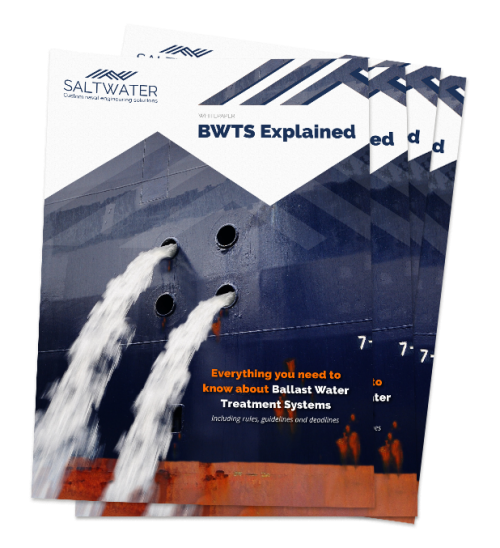
BWTS compliance starts with understanding how ballast water treatment works. Explore the technologies, regulations and engineering considerations in our comprehensive whitepaper.