
Our field of expertise
Engineering Helen for the Fehmarnbelt tunnel project
As part of the Fehmarnbelt tunnel project, FLC commissioned Saltwater to engineer several key systems for Helen, a maintenance barge supporting the equipment used during the immersion of the tunnel elements. Our work focused on preparing the barge for safe and reliable offshore maintenance operations throughout the immersion process.
Saltwater’s scope combined structural, mechanical and detailed engineering across several interconnected parts of Helen. This included the limpet dam drydocks and doors, deck and structural outfitting, and the hoisting frame supports. By engineering these systems as part of one integrated platform, Saltwater helped turn Helen into a fully equipped maintenance barge ready to support the Fehmarnbelt tunnel construction.
Engineering the limpet dams
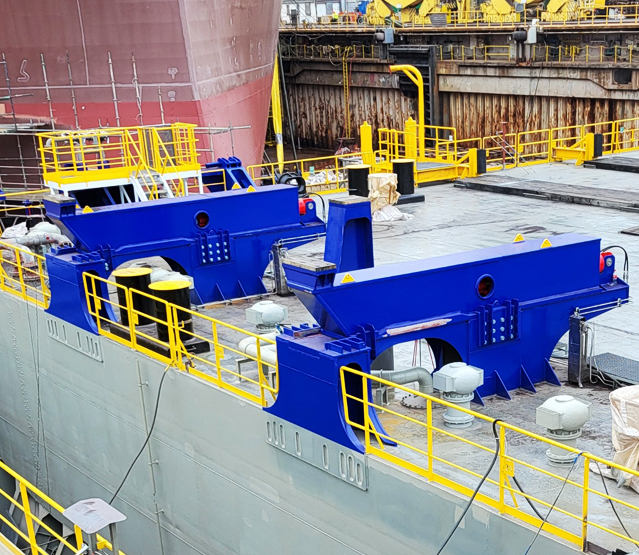
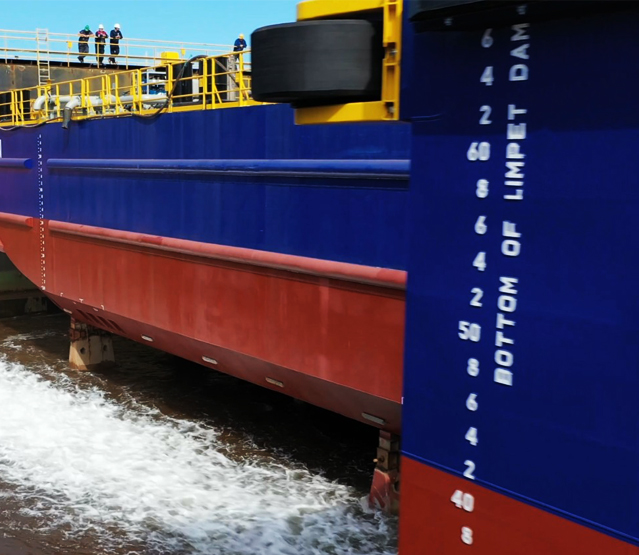
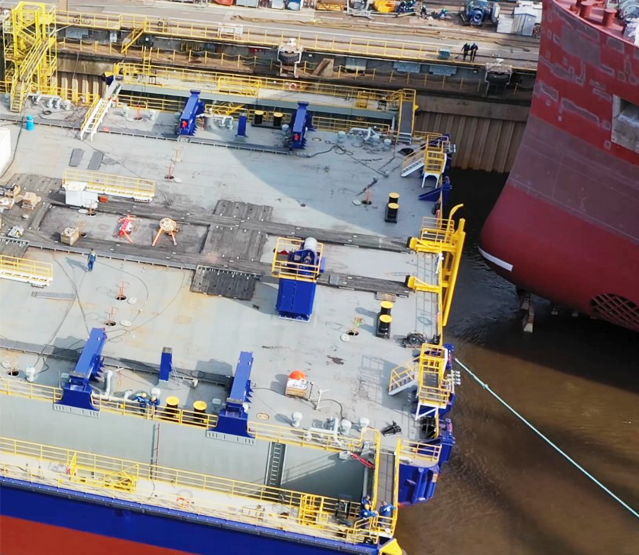
One of the most distinctive features of Helen is the integration of two limpet dam drydocks. These structures provide controlled access to equipment alongside the barge and required both structural engineering and detailed production engineering.
Saltwater developed the limpet dam and its integrated door from the initial structural calculations and general construction plan through to a fabrication ready design.
The complete structure was modeled in 3D using ShipConstructor. From this model, the engineering team generated the construction drawings, cutting files, and profile sketches required for production.
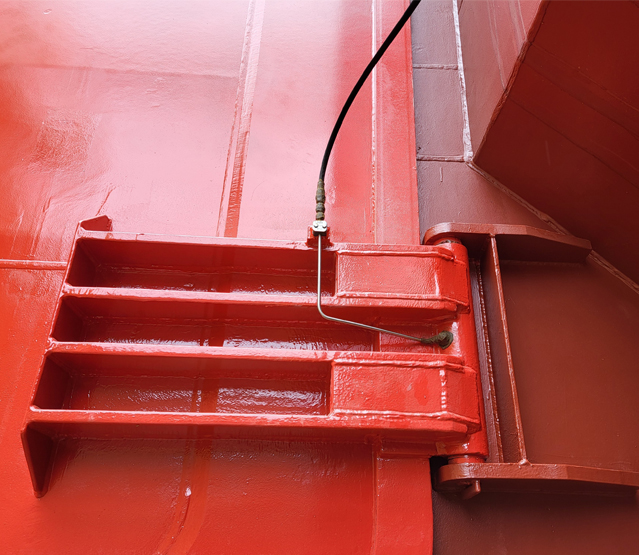
The doors themselves measure approximately 7 by 5 meters and combine considerable size and weight with demanding watertightness requirements. Hydraulic locking pins secure each door in the closed position, while a continuous rubber gasket provides the required seal. Multiple heavy-duty hinges enable controlled and stable movement.
Outfitting the maintenance barge
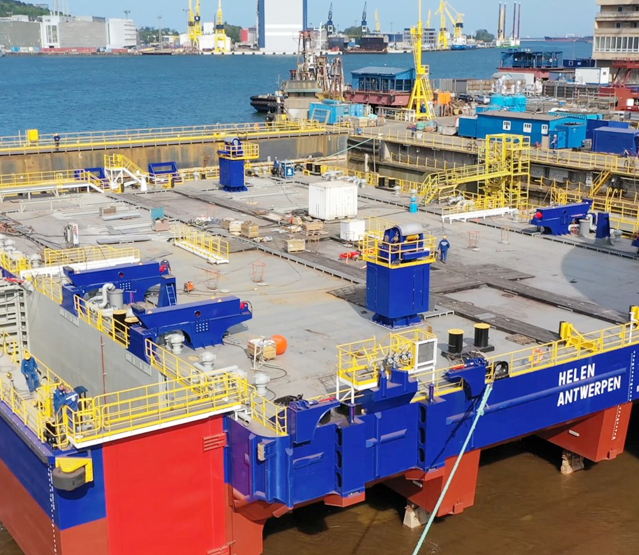
Beyond the limpet dams, Saltwater was responsible for a broad range of structural outfitting on board Helen.
This included walkways and railings, integrated piping below deck, grillages for containerized equipment, draglines supporting crawler crane operations, and lashing points for safe transport.
Although these elements are less visible than the main structures, they are essential to the day-to-day operation of the barge. Careful integration ensures that equipment remains accessible, operations can be carried out safely, and the available deck space is used efficiently.
Hoisting frame supports
Saltwater also performed the detailed engineering of the hoisting frame supports installed on Helen.
Each hoisting frame consists of an upper and lower beam connected by a hydraulic cylinder. The cylinder enables linear movement of the upper beam and therefore required precise integration with the surrounding steel structure.
Because of the complexity of the assemblies, welding and machining operations were first modelled in Autodesk Inventor. This allowed potential fabrication issues to be identified before production.
During this process, the original position of the hydraulic cylinder padeyes was found to leave insufficient space for the specified welds. Together with the client, the design was adapted to use bolted padeye connections instead.
Detailed attention was also given to concentricity, straightness, squareness, flatness, fits and machining tolerances. These requirements ensured correct alignment of the hydraulic components and smooth movement between the upper and lower beams.
The resulting 3D models formed the basis for detailed production drawings covering the welded construction as well as milling, turning, and cutting operations.
From structural concept to production detail
Helen demonstrates the breadth of engineering required to turn a floating structure into a dedicated offshore working platform.
Across the project, Saltwater combined structural engineering, mechanical integration, detailed engineering and outfitting into one coordinated solution. From large watertight doors to hydraulic equipment and the smaller details that make daily operations possible, each component was engineered with fabrication, installation and operation in mind.

Specific project data
Project information
Scope of work:
- Structural engineering and integration of the limpet dams
- Detailed engineering of two limpet dam drydocks and four doors
- Deck and structural outfitting
- 3D modelling and production engineering
- Detailed engineering of the hoisting frame supports
- Hydraulic cylinder selection and integration
- Definition of welds, fits and tolerances
- Production drawings for welded and machined components
Deliverables:
- Structural calculations and construction plans
- Detailed engineering package
- 3D production models
- Cutting files and profile sketches
- Hydraulic cylinder integration
- Fabrication and production drawings